Introduction
Democracy is often discussed in grand terms: institutions, elections, representation, legitimacy. Yet for many people, democracy is experienced much more simply. It is the question of whether anyone listens when they speak. It is the feeling of whether public decisions reflect lived reality. It is the distance between the citizen and the room where decisions are made.
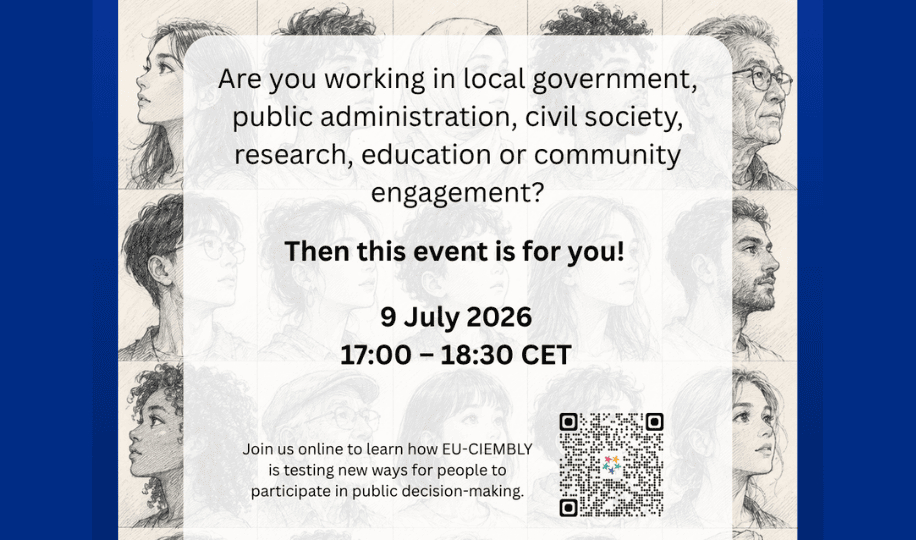
On 9 July 2026, EU-CIEMBLY will host its Oral Exhibition: The Future of Local Governance, a live virtual event showcasing the results of Citizens’ Assemblies held in the UK and Cyprus. The event will take place via Zoom from 17:00–18:30 CET / 18:00–19:30 EET, with live interpretation in English and Greek and free registration.
But this is not simply another project event. It is an invitation to look closely at a different democratic practice: one where citizens are not treated as passive audiences, but as people capable of learning, deliberating, disagreeing, and producing recommendations on issues that affect their lives.
At its core, the EU-CIEMBLY Oral Exhibition asks a deceptively simple question:
How do we rebuild trust between citizens and local government in an era of change?
1. From Consultation to Co-Creation
Public participation often fails when it arrives too late. Citizens are asked to comment after decisions have already been framed, filtered, and narrowed. EU-CIEMBLY works from a different starting point: if people are affected by public decisions, they should help shape the conversation before those decisions are made.
The project is designed to create an inclusive model for Citizens’ Assemblies across and beyond the European Union, with a focus on intersectionality, equality, and meaningful democratic participation.
This matters because participation is not automatically inclusive. A meeting can be “open” and still exclude people through language, format, confidence, time, access, or social power. A consultation can be technically available while remaining practically unreachable. EU-CIEMBLY’s contribution is to treat inclusion not as decoration, but as design.
2. Housing as a Democratic Test
The Assemblies in Colchester and Cyprus focused on housing, one of the most urgent and personal policy challenges facing communities. Housing is not only about buildings, rents, or prices. It is about security, dignity, family life, migration, youth independence, ageing, education, and belonging.
In Colchester, the pilot brought together 50 participants, including University of Essex students and local residents, to explore housing challenges and develop recommendations. The process unfolded across three stages: an online session, an in-person session, and a final online session.
The Colchester Assembly also tested a structured co-design approach. Rather than designing the assembly only for participants, the process was shaped with communities and stakeholders close to the issues. This included discussion on who should participate, what support would be needed, how the assembly should run, and how recommendations should be adopted and communicated.
In Cyprus, the Citizens’ Assembly on housing brought together citizens from different regions and social groups to exchange views, share personal experiences, and develop ideas and recommendations. Participants were supported by trained facilitators so that all voices could be heard respectfully and equally.
3. The Power of the Oral Exhibition
The Oral Exhibition is powerful because it does not only present outcomes. It presents the people behind the outcomes.
Reports are essential. Recommendations are essential. But public understanding often needs more than written findings. It needs faces, voices, pauses, emotions, and stories. It needs to show what participation feels like from inside the room.
The event will include documentary screenings from the UK and Cyprus pilots, showing the deliberation process of the two Citizens’ Assemblies, followed by discussion of the recommendations on housing. The agenda also includes sessions on redefining European democracy, embedding intersectionality in policy design, local governance, and the next steps for the project.
This turns the event into more than a dissemination exercise. It becomes a democratic archive: a record of citizens thinking together.
4. Intersectionality as Democratic Infrastructure
One of EU-CIEMBLY’s strongest messages is that democracy cannot be inclusive by accident. It must be built to notice exclusion.
Intersectionality helps reveal how people experience public issues differently depending on overlapping factors such as age, gender, ethnicity, disability, income, migration background, education, and place. In participation processes, these differences shape who feels confident speaking, who has the time to attend, who trusts the process, and whose experiences are treated as knowledge.
EU-CIEMBLY’s framework explicitly seeks to address patterns of exclusion from Citizens’ Assemblies by using intersectionality as a lens for understanding and overcoming structural marginalisation.
This is why the Oral Exhibition is relevant not only to researchers, but also to municipalities, public administrations, civil society organisations, and policymakers. The question is not simply whether Citizens’ Assemblies are interesting. The question is whether they can become practical tools for fairer, more responsive local decision-making.
5. Local Governance Begins with Trust
Local government is often where democracy becomes visible. It is where housing problems are felt, where public services are accessed, where neighbourhoods change, and where citizens most directly encounter the state.
But trust cannot be rebuilt through slogans. It requires repeated evidence that public institutions are willing to listen, explain, adapt, and share power in meaningful ways.
The EU-CIEMBLY event offers a glimpse of what this could look like: citizens learning together, facilitators creating safe spaces, experts supporting without dominating, policymakers receiving recommendations, and communities seeing their experiences reflected in public dialogue.
The project’s wider pathway includes local, national, and transnational pilots, with the goal of producing lessons and recommendations for policymakers on how Citizens’ Assemblies can be designed in more inclusive and impactful ways.
Conclusion: Democracy with a Human Voice
The future of democracy will not be secured only through institutional reform, digital tools, or policy papers. It will also depend on whether people can see themselves in public decision-making.
The EU-CIEMBLY Oral Exhibition offers exactly that: a space where citizens’ voices are not background noise, but the centre of the story.
It asks local authorities to imagine participation not as a box to tick, but as a relationship to build. It asks policymakers to treat lived experience as democratic evidence. And it asks citizens to recognise that their voices can travel beyond the assembly room and into the future of public policy.
On 9 July 2026, EU-CIEMBLY will not simply showcase two Citizens’ Assemblies. It will show what democracy can sound like when people are genuinely invited to speak.