
Introduction
European Cohesion Policy is often described through programmes, funds, regulations, eligible costs and strategic objectives. For many citizens, however, this language can feel distant from everyday life. It explains what Europe funds, but not always why it matters.
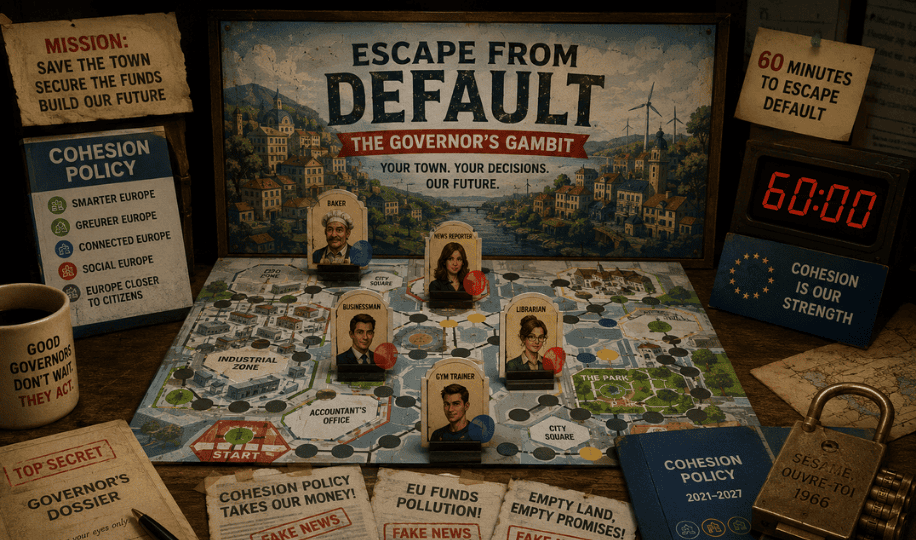
This is the challenge that Escape from Default: The Governor’s Gambit, an escape-the-room game developed by Breez© for the Cohesion Policy project, sets out to address. Instead of asking participants to passively receive information, the game places them inside a fictional crisis: a town on Cohesion Island is on the brink of financial ruin, public trust has collapsed, misinformation is spreading, and the future of the community depends on one thing — whether the players can understand, defend and correctly use EU Cohesion Policy before time runs out.
The result is not just a game. It is a carefully designed learning experience where policy becomes story, funding becomes strategy, misinformation becomes an obstacle, and participation becomes the only way forward.
Controlling the Learning Experience
The strength of Escape from Default lies in its ability to transform a technical policy subject into an immersive civic mission. Players are not told that Cohesion Policy supports regions, reduces inequalities and funds green, social and economic development. They experience those ideas through pressure, puzzles, debate and discovery.
1. The Crisis as a Gateway to Understanding
The game begins with urgency. Participants are newly elected governors of a struggling town. Previous leaders have failed. The town is close to default. Antagonists are spreading lies and waiting for collapse so that they can profit from selling the land to polluting corporations.
This immediately gives Cohesion Policy a purpose. It is no longer an abstract EU mechanism. It becomes the difference between decline and recovery.
The storyline turns the policy question into a civic question: how does a community survive when trust is low, resources are limited and bad actors benefit from failure? In this context, the European Regional Development Fund, the Cohesion Fund, the European Social Fund Plus and the Just Transition Fund are not presented as acronyms to memorise. They become tools that can help a town rebuild its economy, protect its environment, support its people and reconnect with its citizens.
2. The Villain, the Town and the Public Good
Like any effective narrative, the game creates tension through conflict. The town has helpers, sceptics and antagonists. The Gym Trainer, Librarian, News Reporter, Baker and Businessman each provide fragments of information, but not all of them can be trusted.
This character system does something important: it teaches participants that public decision-making is rarely clean or straightforward. Citizens and institutions must listen, compare evidence, identify interests and distinguish useful knowledge from manipulation.
The Businessman, for example, appears supportive but gives misleading information. His role introduces a familiar real-world lesson: misinformation is often not obvious at first glance. It can be wrapped in friendly language, partial truths or personal interest.
In this way, the game avoids presenting Cohesion Policy as a simple “EU success story”. Instead, it places it inside a contested public space where trust has to be earned.
3. Misinformation Becomes a Puzzle
One of the most powerful parts of the game is the City Square activity. Players encounter fake articles claiming, among other things, that Cohesion Policy takes money away from communities, funds pollution, wastes money on empty land, or ignores innovation.
To progress, they must fact-check these claims using real examples and official information. They discover that the Cohesion Fund can finance up to 85% of eligible costs, that climate objectives are built into Cohesion Policy, that major investments support hospitals in Romania, and that EU support can reach innovative companies, including in the space and technology sectors.
This is where the game becomes more than an educational exercise. It becomes a media literacy simulation.
Participants are not simply told that misinformation is harmful. They must confront it, test it and replace it with evidence. The mechanic is simple, but the civic lesson is deep: democracy depends not only on having information, but on knowing how to verify it.
4. Policy Through Movement, Pressure and Teamwork
The escape-room format also changes how people relate to policy content. Instead of sitting through a presentation, participants move across a physical map, interact with stations, solve riddles, scan QR codes, complete quizzes, search online, weigh objects, uncover hidden messages and negotiate answers as a team.
Each activity translates a policy concept into action.
The Accountant’s Office introduces the four main Cohesion Policy funds through categorisation and logic. The Park connects public communication with youth engagement through a social media challenge. The Industrial Sector introduces the Just Transition Fund through a tactile exercise involving polluted soil, a hidden “clean energy core” and metric precision. The Town Hall brings everything together by requiring players to identify the five Policy Objectives of Cohesion Policy for 2021–2027.
The design makes learning active. Participants do not merely hear about smart, green, connected, social and citizen-focused Europe. They need those ideas to unlock the final stage of the game.
5. The Final Unlock: From Knowledge to Agency
The final challenge takes place at the Town Hall, where the players must restore the erased policy objectives and use the secret passphrase, “Sésame, ouvre-toi 1966,” to access the mainframe and save the town.
Symbolically, this is a strong ending. The players can only succeed if they combine evidence, memory, teamwork, multilingual clues and policy knowledge. No single puzzle is enough. No single character has the whole truth. No single player can carry the process alone.
That is also the larger message of Cohesion Policy.
Regional development is not achieved through one fund, one project or one institution. It requires coordination, trust, public understanding and the ability to connect local needs with wider European priorities.
Conclusion
Escape from Default: The Governor’s Gambit shows how complex public policy can be transformed into an engaging civic experience without losing its substance.
By combining narrative, puzzles, fact-checking, physical interaction and digital engagement, Breez© has created a game that helps participants understand not only what Cohesion Policy is, but why it matters. It makes visible the links between EU funding and everyday issues such as jobs, climate resilience, local development, public services, innovation and trust.
At its core, the game reminds us that Cohesion Policy is not just about money. It is about the capacity of communities to imagine a future, defend it from misinformation, and work together to make it possible.
In a time when public trust is fragile and policy communication often struggles to reach citizens, Escape from Default offers a different path: do not just explain Europe — let people step inside the story and try to save the town themselves.